
Why Chongqing Feels Like a Real-Life Cyberpunk City
Why Chongqing Feels Like a Real-Life Cyberpunk City
Before I came to Chongqing, the word “cyberpunk” only existed in movies for me.
It was the rainy skyscrapers of Blade Runner, the neon alleys of Ghost in the Shell, and the dystopian atmosphere of The Matrix.
But the moment I stood inside a crowded elevator near Jiefangbei and looked up at a monorail gliding between buildings above my head, while scooters rushed through steaming alleyways full of hotpot restaurants below, I suddenly understood something:
Chongqing is not like a cyberpunk city.
It is cyberpunk — just in real life.
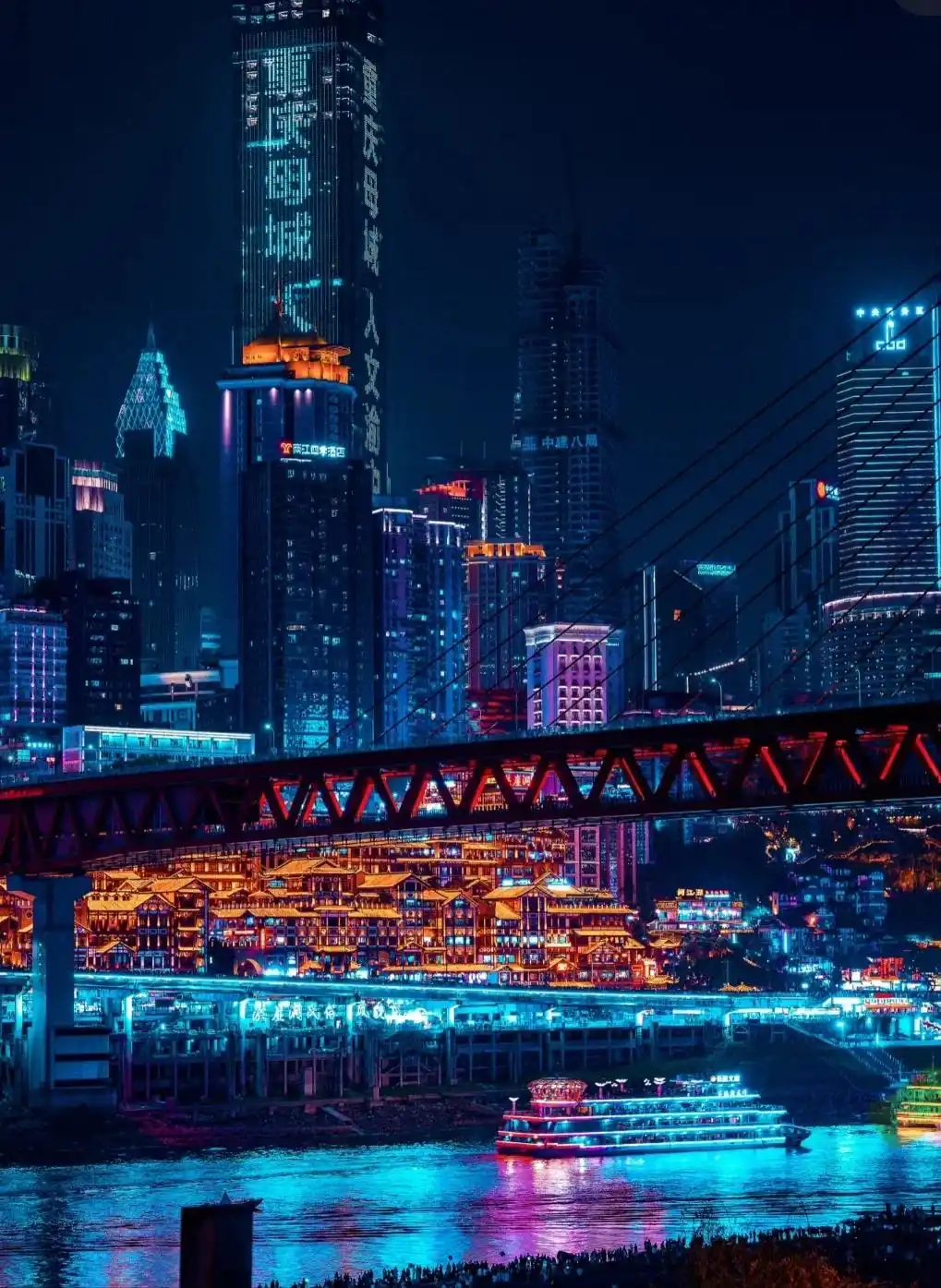
A City Built in Vertical Layers
Most cities are horizontal.
Chongqing is vertical.
Roads overlap roads.
Buildings grow out of cliffs.
Bridges hang over rivers like giant steel dragons.
And entire neighborhoods exist on different elevations at the same time.
In Chongqing:
- The 11th floor can open directly onto a street.
- The 1st floor can also open onto another street.
- You might walk “downstairs” and accidentally arrive eight floors lower.
- GPS navigation regularly loses its mind.
This is why people call Chongqing an “8D Magic City.”
The city feels less like urban planning and more like someone stacked multiple versions of reality on top of each other.
From the ground you see highways.
Above the highways:
restaurants.
Above the restaurants:
apartments.
Above the apartments:
libraries, offices, rooftop bars, and more highways.
It feels like a giant playable map from a futuristic video game.
The Train That Runs Through a Building
Nothing represents Chongqing’s cyberpunk reputation better than Liziba Station.
Yes — the train literally passes through a residential building.
When I arrived there at night, every passenger inside the metro pressed against the windows with phones in hand.
Including me.
Outside the glass, I could see laundry hanging on balconies only meters away.
A child jumping in a living room.
Someone cooking dinner.
Then the train disappeared into the building itself.
For a second, reality stopped making sense.
But somehow, Chongqing makes impossible things feel normal.
What sounds absurd elsewhere becomes practical here because of the mountain terrain.
The station was actually designed this way intentionally — a brilliant engineering solution to the city’s extreme geography.
And after operating safely for more than 20 years, it has become one of the most iconic urban scenes in China.

The Infrastructure Feels Like Science Fiction
Cyberpunk is not only about neon lights.
It is also about infrastructure overwhelming human perception.
And Chongqing does that perfectly.
The city has:
- Over 20,000 bridges
- Multi-level highways twisting through mountains
- Massive layered overpasses
- Metro systems built into cliffs
- Endless tunnels cutting through hills
The most famous example is Huangjuewan Interchange.
It has:
- 5 levels
- 20 ramps
- 8 directions
Even experienced drivers sometimes take the wrong exit there.
From above, it looks almost unreal — like a circuit board floating over the city.
Unlike cities built on flat land, Chongqing had no choice but to innovate vertically.
And somehow, those geographic limitations became its greatest visual identity.
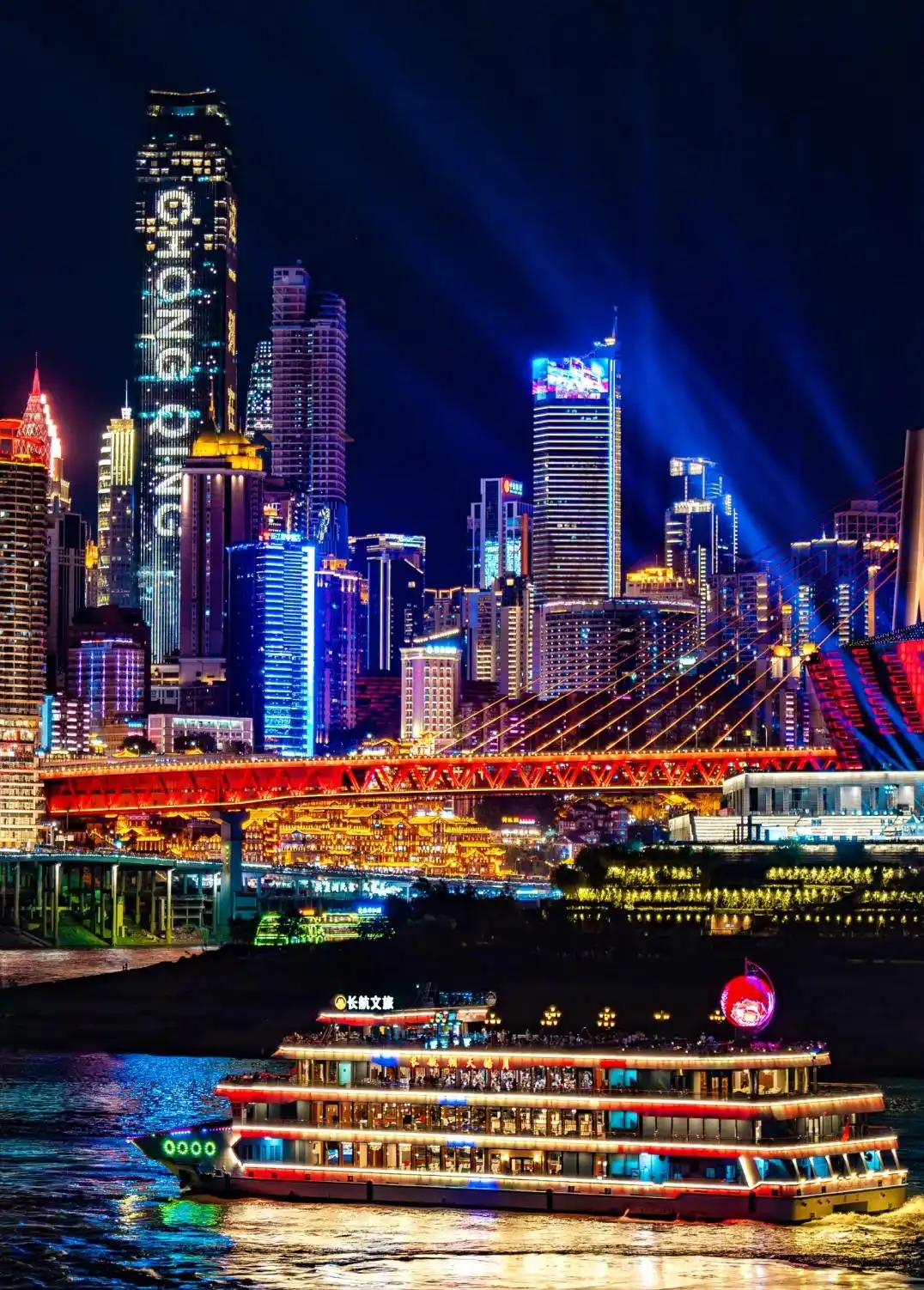
Chongqing at Night Feels Different
Many cities are beautiful at night.
Chongqing feels alive at night.
I went to TestBed 2, a renovated factory district built into the hillside.
On one side:
the smell of fried chicken.
On another:
a guitarist singing in a small bar.
Ahead:
the glowing skyline of Yuzhong District.
Behind:
old walls covered with handwritten love messages.
The city lights here do not feel clean or futuristic in a sterile way.
They feel humid.
Dense.
Heavy.
Human.
The air itself seems filled with steam, traffic noise, hotpot smoke, neon reflections, and river fog.
That is what makes Chongqing different from Silicon Valley-style futurism.
Its cyberpunk feeling is not “cold technology.”
It is “hot humanity.”
Hotpot Is the Language of Chongqing
If infrastructure is the skeleton of Chongqing, hotpot is its soul.
I walked into a random hotpot restaurant near Guanyinqiao and ordered a small spicy beef tallow pot for myself.
The soup was dark red.
Almost black.
At the next table, several young locals laughed while complaining about work and dipping food into bowls of garlic oil sauce.
I tried a piece of tripe.
By the third bite, I was sweating.
But strangely happy.
Because Chongqing hotpot is not only food.
It is emotional release.
The city does not ask:
- Who are you?
- Where are you from?
- What do you do?
It simply gives you:
- a boiling pot,
- a stool,
- strong chili oil,
- and permission to disappear into the moment.
By the end of that meal, I felt like Chongqing had accepted me.
Why Foreign Travelers Are Obsessed With Chongqing
In recent years, Chongqing has exploded across TikTok, YouTube, Instagram, and Reddit.
For many international travelers, it represents a side of China they never expected to see.
Not ancient temples.
Not traditional gardens.
But a giant futuristic megacity hidden deep inside the mountains.
And Chongqing is actively embracing that image.
Drone light shows now illuminate the skyline.
Night tourism routes attract millions.
Observation decks overflow with photographers.
Foreign influencers describe it as:
- “the closest city to Blade Runner”
- “China’s cyberpunk capital”
- “the most futuristic city on Earth”
At the 2026 Chongqing International Travel Agents Conference, nearly 300 guests from around 40 countries gathered in the city.
That would have sounded unimaginable decades ago, when Chongqing was still associated with isolation and difficult mountain travel.
Now, it has become one of China’s strongest international urban brands.
More Than a Viral City
Many internet-famous cities attract attention briefly and disappear.
Chongqing feels different.
Because behind the “cyberpunk” visuals is a complete urban system:
- advanced transportation,
- massive infrastructure,
- tourism optimization,
- mobile payment convenience,
- international-friendly services,
- and a deeply unique local culture.
The city has successfully transformed:
- geographic disadvantages
into - unforgettable identity.
That is the real reason Chongqing works.
Its magic is not fake.
It grew naturally from mountains, rivers, engineering, chaos, and human adaptation.
Chongqing Is Not Escapism — It Is Controlled Chaos
What surprised me most was not the skyline.
It was how the city changed my mental state.
In Chongqing, planning becomes meaningless.
You stop trying to control everything.
You simply walk.
Climb.
Get lost.
Sweat.
Eat.
Look around.
And somewhere between a staircase, a monorail, and a bowl of noodles in a tiny alley, your anxiety becomes smaller.
Chongqing does not heal you gently.
It overwhelms you until your inner noise disappears.
Maybe that is why so many people become emotionally attached to this city.
Because here, life does not need to be perfectly organized.
It only needs to feel alive.
Final Thoughts
If someone asked me which city best represents the futuristic feeling of modern China, my answer would be simple:
Chongqing.
Not because it looks futuristic.
But because it turned impossible geography into an entirely new kind of urban civilization.
A place where:
- trains pass through buildings,
- bridges float between mountains,
- neon lights reflect on river fog,
- and ordinary life feels cinematic.
Chongqing is not science fiction.
It is what happens when reality becomes stranger, louder, hotter, and more layered than imagination itself.
Related Topics
- Best Cyberpunk Cities in the World
- Why Foreigners Are Visiting Chongqing
- China’s Most Futuristic Cities
- Chongqing Nightlife Guide
- Real-Life Blade Runner Cities
- Best Places to Visit in Chongqing